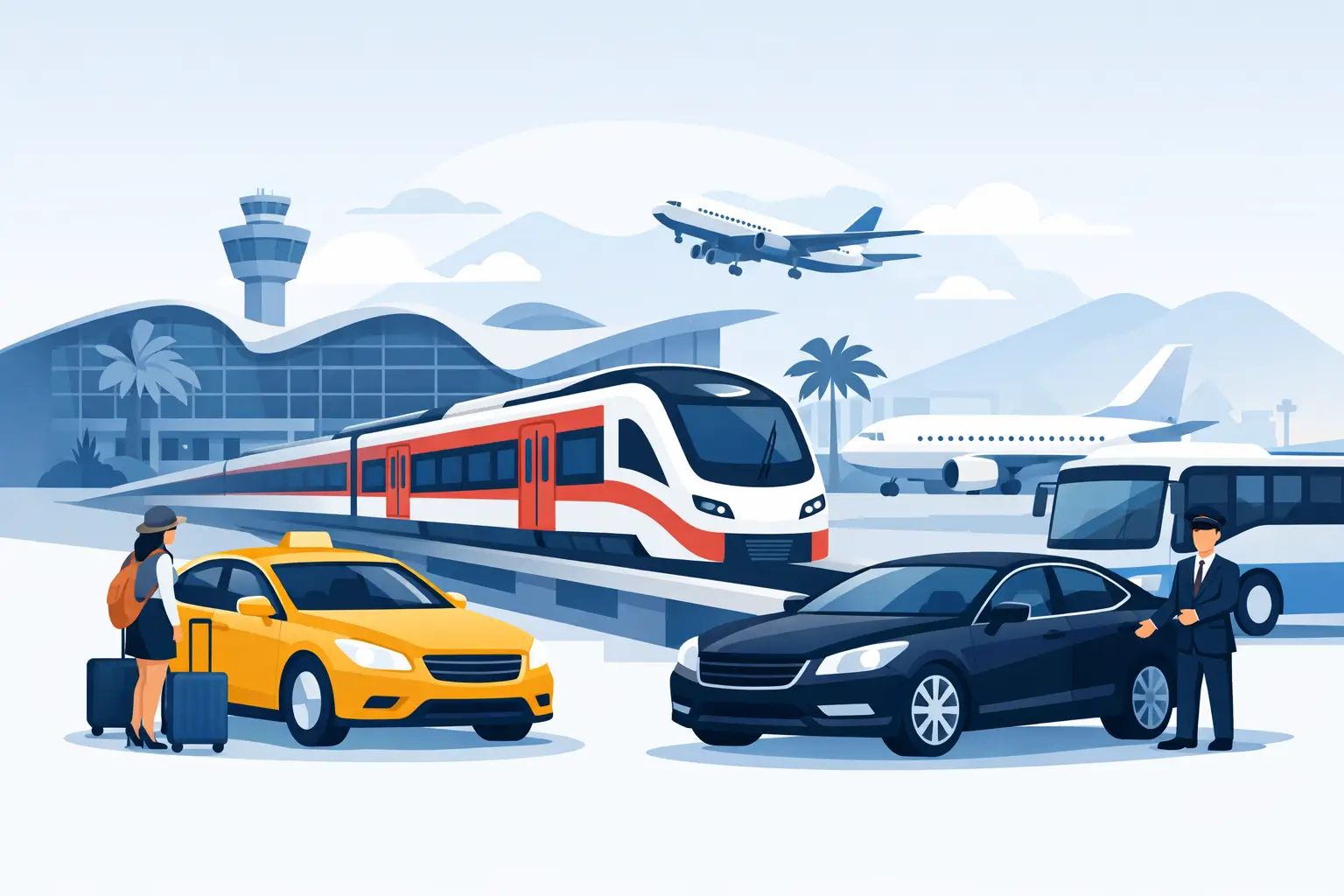
You land at KLIA after a long flight, clear immigration, collect your bags, and then the real decision starts - how do you get where you need to go without wasting time or dealing with price surprises? For many travelers, the best transport for KLIA arrivals depends less on what is cheapest on paper and more on what is reliable after a tiring trip, especially if you have luggage, family members, or a fixed schedule.
KLIA and KLIA2 handle a high volume of domestic and international passengers, and the arrival experience can vary by hour, airline, and terminal. A solo traveler heading into central Kuala Lumpur has different priorities from a family going to a hotel in Petaling Jaya or a business traveler continuing straight to a meeting. That is why the right answer is not the same for everyone.
Best transport for KLIA arrivals depends on your trip
If your priority is speed into the city center, the airport train is often the strongest option. If your priority is direct door-to-door convenience, a pre-booked private transfer is usually the better fit. If you are focused mainly on keeping costs low and your timing is flexible, buses can work well. Taxis and ride-hailing sit somewhere in the middle, but the experience can be less predictable during busy periods.
The most practical way to choose is to look at four things first: your final destination, how much luggage you have, your arrival time, and how much certainty you want before landing. Those details matter more than broad claims about one option always being best.
Private airport transfer
For many visitors, especially families, groups, and travelers arriving after a long-haul flight, a private airport transfer is the most dependable choice. You book in advance, the price is fixed, and the trip is built around your arrival rather than around station transfers, queues, or last-minute app availability.
This matters more than people expect. KLIA is not always the end point of the journey. Many passengers are heading to hotels, homes, offices, convention venues, or even other cities. A private transfer removes the extra layer of figuring out train changes or standing in line for a taxi after baggage claim.
Another advantage is flight monitoring. If your arrival is delayed, a properly managed transfer service can adjust pickup timing based on the updated flight status. That lowers the chance of miscommunication and makes the handoff easier, particularly for international travelers arriving in Malaysia for the first time.
The trade-off is cost. A private ride is usually more expensive than a bus and can cost more than the train for a solo passenger heading to a station-accessible area. But once you are traveling with two or more people, carrying large bags, or going to a location outside the city core, the value becomes clearer. Door-to-door service often saves both time and hassle.
Train from KLIA to central Kuala Lumpur
If you are traveling light and staying near a station in central Kuala Lumpur, the airport train is one of the fastest options. It is straightforward, air-conditioned, and avoids road traffic. For a solo traveler who wants a quick transfer into the city and is comfortable managing the last part of the trip separately, this can be a smart choice.
The limitation is that the train only solves part of the journey. Once you arrive in the city, you may still need another ride to reach your hotel or apartment. That is usually manageable if you are carrying a backpack and arriving during normal hours. It becomes less attractive if you have multiple suitcases, children, elderly relatives, or an address far from the station.
So while the train is excellent for certain arrivals, it is not automatically the best transport for KLIA arrivals across the board. It is best for point-to-point airport-to-city-center travel, not full end-to-end convenience.
Airport bus
Buses appeal to budget-conscious travelers, and they can be perfectly reasonable if your schedule is flexible. They are generally cheaper than private transfers, taxis, or rail. If you are not in a hurry and your destination lines up well with the bus route, this option can do the job.
The issue is predictability. Buses involve waiting times, set stops, and less flexibility if your flight lands late or you miss a departure window. After a red-eye flight, even a short wait can feel much longer. If your destination is still far from the bus drop-off point, you may end up adding another transfer anyway.
For backpackers or solo travelers trying to keep transport costs down, the bus remains useful. For families, business travelers, or anyone landing with tight plans, it is usually not the easiest arrival option.
Taxi and ride-hailing
Taxis and app-based rides are familiar choices for many travelers because they do not require much advance planning. You land, request a ride or join a queue, and head out. In some situations, that simplicity works well.
Still, there are trade-offs. Availability can fluctuate during peak arrival periods, public holidays, or bad weather. Fares may also vary depending on demand, route, or traffic conditions. That can make budgeting harder, particularly for visitors who want price certainty before they leave the terminal.
There is also the issue of vehicle size. A standard car may not be practical if you are carrying extra luggage or traveling as a group. You may need to wait longer for a suitable vehicle, and that can erase the convenience advantage.
For short-notice travel, taxis and ride-hailing remain useful fallback options. But if you prefer a confirmed pickup, a known fare, and a vehicle matched to your group size, pre-booking is usually more reassuring.
When a private transfer is the best option
There are a few situations where private transport stands out clearly. One is when you are arriving with family, especially with young children or older relatives. Another is when you have multiple bags, sports equipment, strollers, or shopping luggage that make station changes inconvenient.
It also makes sense if you are arriving late at night, early in the morning, or during a tight connection to another appointment. Business travelers often prefer private transfers for exactly this reason - fewer variables, less waiting, and direct arrival at the destination.
Group travel changes the math as well. Once several passengers are sharing one vehicle, the cost difference between options often narrows. At that point, the convenience of staying together and going straight to the door can outweigh the savings of public transport.
Travelers continuing beyond Kuala Lumpur should think about this carefully too. If your destination is not in the city center, but in areas such as Johor Bahru or Penang after an onward journey, or somewhere outside the main rail corridor, a direct pickup is far easier to manage than combining multiple transport stages.
How to choose the best transport for KLIA arrivals
Start with your final address, not just the airport. If your hotel is next to a train station, rail may be the fastest practical option. If your destination is a residential neighborhood, business district, or suburban area, direct transport usually makes more sense.
Then look at the time of arrival. Midday arrivals give you more flexibility across all transport types. Late-night or early-morning landings make reliability more valuable. That is where fixed-rate private service becomes especially useful because your arrangements are confirmed before you land.
Next, consider your group and baggage. One traveler with one carry-on can move easily. A family of four with checked luggage needs a different level of coordination. It is better to choose based on comfort and practicality than to chase the lowest possible fare and regret it after 30 minutes in a queue.
Finally, ask yourself how much uncertainty you are willing to accept. Some travelers are comfortable making decisions on arrival. Others want everything arranged in advance. Neither approach is wrong, but the second usually leads to a calmer airport exit.
A practical recommendation for most arrivals
If you are a solo traveler staying in central Kuala Lumpur and packing light, the train is hard to beat for speed. If your priority is the lowest upfront cost and you have time to spare, the bus can work. If you are landing without a plan and need immediate transport, taxis and ride-hailing are available but less consistent.
For everyone else - families, groups, first-time visitors, business travelers, and anyone who values fixed pricing and door-to-door convenience - a pre-booked private transfer is often the strongest overall choice. That is why many travelers use services like Cab2Travel for KLIA and KLIA2 pickups: the process is simple, the fare is clear, and the trip starts with less stress.
The best arrival transport is the one that fits the reality of your trip, not just the headline price. After a flight, certainty is often worth more than saving a small amount and sorting out the rest on the curb.