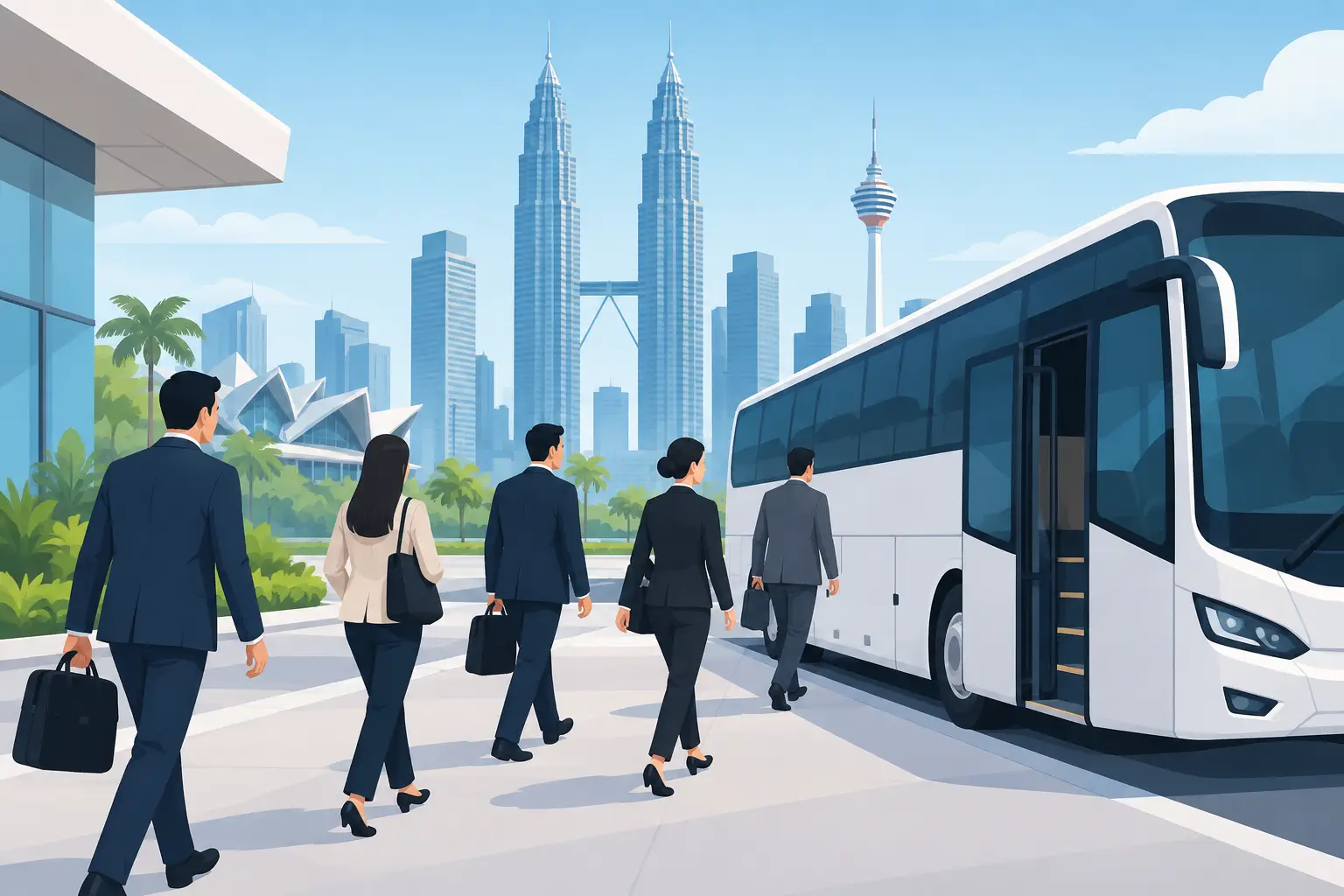
A corporate roadshow transport example is most useful when it reflects the pressure of a real business schedule: executives arriving on different flights, meetings in more than one city, equipment to move, and no room for a missed pickup. For teams traveling through Kuala Lumpur, Johor Bahru, or Penang, private pre-booked transport gives organizers one clear plan instead of a series of separate ride requests.
Consider a three-day investor and client roadshow based in Kuala Lumpur. A regional sales team is hosting presentations at a city-center hotel, a client office in Petaling Jaya, and a dinner meeting near KLIA before several attendees fly out. The group includes six executives, two support staff members, presentation materials, and checked luggage. Their transport plan needs to be punctual, easy to track, and priced clearly before the trip begins.
A Corporate Roadshow Transport Example: Three Days, Multiple Stops
On Day One, two executives land at KLIA on an early-morning international flight, while the remaining team members arrive at KLIA2 later that morning. Rather than asking each traveler to find transportation independently, the organizer schedules two private airport pickups with the flight details provided in advance. Flight monitoring helps the transport provider adjust for a delayed arrival, while the driver meets each group at the agreed pickup point.
The first vehicle takes the early arrivals and their luggage directly to the hotel. The second vehicle collects the later group and travels to the same location. Because the rate is fixed at booking, the organizer can confirm the transport cost without having to account for demand-based fare changes after a long flight.
That afternoon, the full team travels from the hotel to a presentation venue in the city center. A suitable MPV or van is assigned based on passenger count and luggage requirements. The vehicle remains scheduled for the return trip, so the team is not waiting outside a venue trying to coordinate several separate rides during a busy business district pickup period.
Day Two involves the most complex timing. The group leaves the hotel at 8:15 a.m. for a 9:00 a.m. client meeting in Petaling Jaya. After the meeting, they need to stop at a restaurant for lunch, return briefly to the hotel for a change of materials, and continue to a second presentation in Kuala Lumpur. A dedicated driver follows the confirmed itinerary and waits according to the agreed schedule.
This arrangement is particularly helpful when the schedule shifts by 15 or 20 minutes. A roadshow does not always run exactly to plan. A client may extend a discussion, a presenter may need more setup time, or traffic may affect the ideal departure time. The organizer should give the driver a primary contact number and a simple process for communicating changes. That keeps decisions centralized and prevents mixed instructions from multiple passengers.
On Day Three, the team checks out, travels to a final breakfast meeting near KLIA, and then separates for departures. One vehicle transfers four passengers to KLIA, while another takes two travelers to KLIA2. Using separate vehicles at this point may cost more than keeping everyone together, but it reduces the risk of one flight schedule affecting another. For a roadshow, the best choice is not always the lowest-cost option. It is the option that protects the most important timing commitments.
What Makes This Roadshow Plan Work
The key is to treat transport as part of the event schedule, not an item to arrange after flights and meetings are confirmed. The organizer should know who is traveling, where they need to be, what they are carrying, and how much flexibility each transfer requires.
Start with the passenger list. Six people with cabin bags may fit comfortably in an MPV, but six people with large suitcases, sample products, or presentation equipment may require a larger vehicle. Vehicle capacity is about more than seats. A crowded luggage area can delay loading, make passengers uncomfortable, and create unnecessary stress at the airport.
Next, build the itinerary around required arrival times rather than meeting start times. If a presentation begins at 10:00 a.m., the team may need to arrive at 9:15 a.m. to check in, set up equipment, and settle before guests arrive. The pickup time should account for expected traffic, building access, and a reasonable buffer. For important meetings, it is better to arrive early than to explain a late arrival caused by an overly tight transport plan.
A clear itinerary should include the date, pickup location, pickup time, destination, expected return or next departure time, passenger count, luggage estimate, and on-site contact. It should also identify which stops are fixed and which may change. For example, a hotel-to-client-office transfer may be fixed, while the choice of lunch venue may depend on when the meeting ends.
Airport Coordination Requires More Than a Flight Number
Airport transfers are often the first and last impression of a roadshow. They need specific planning, especially when delegates arrive on different airlines or at different terminals. Share each flight number, scheduled arrival time, passenger name, and mobile contact in advance. This allows the driver and transport coordinator to prepare for the right arrival window.
International travelers may need extra time for immigration and baggage collection. A pickup plan should not assume that a flight landing time is the same as a passenger-ready time. It also helps to confirm the meeting point before travel begins. After a long flight, a guest should not be searching through messages to work out where to go.
If the team is carrying marketing displays, product samples, or multiple large cases, mention this during booking. The right vehicle choice at the airport prevents a common roadshow problem: passengers fit, but their equipment does not. For larger groups or substantial luggage, a van may be a better operational choice than trying to divide the group across several smaller vehicles.
When One Vehicle Is Enough and When It Is Not
A single vehicle is easier to manage when the entire group follows the same schedule. It keeps the team together, simplifies communication, and gives the organizer one main transport contact. It is often the practical option for a small delegation traveling between a hotel, meetings, and group dinners.
However, separate vehicles are worth considering when senior executives have different flight times, when teams must attend parallel meetings, or when one group needs to leave before another. Splitting the transport plan adds coordination, but it can protect the schedule. For instance, sending a smaller vehicle to take two executives to the airport while the rest of the team finishes a client session prevents an early departure from disrupting the entire group.
The same decision applies to premium vehicle requirements. A standard private MPV may be suitable for a working team, while a premium vehicle may be appropriate for a visiting executive or an important client. The choice depends on the purpose of the trip, passenger expectations, and the image the host company needs to present.
How to Book Roadshow Transport With Fewer Gaps
Provide the full schedule as early as possible, but do not wait for every minor detail before reserving vehicles. The core elements - dates, primary routes, group size, flight details, and major meeting times - are enough to secure a workable plan. Final restaurant stops or exact return times can be refined later.
Ask for fixed pricing for the confirmed itinerary and clarify what happens if the route, waiting time, or passenger count changes. Clear terms matter because roadshows can evolve quickly. A transparent transport provider should explain the plan in plain language, including vehicle type, pickup instructions, and the contact process for changes on the day.
Cab2Travel can support this type of private business travel with pre-booked airport transfers, intercity rides, and vehicle options for small groups. For organizers, the practical value is simple: one transport arrangement, professional drivers, and a schedule built around the team rather than the availability of individual rides.
Before the first pickup, send travelers one final message with the vehicle details, driver contact process, pickup time, and a reminder to be ready a few minutes early. That small step gives every attendee the same information and lets the roadshow begin with a calm, organized departure.