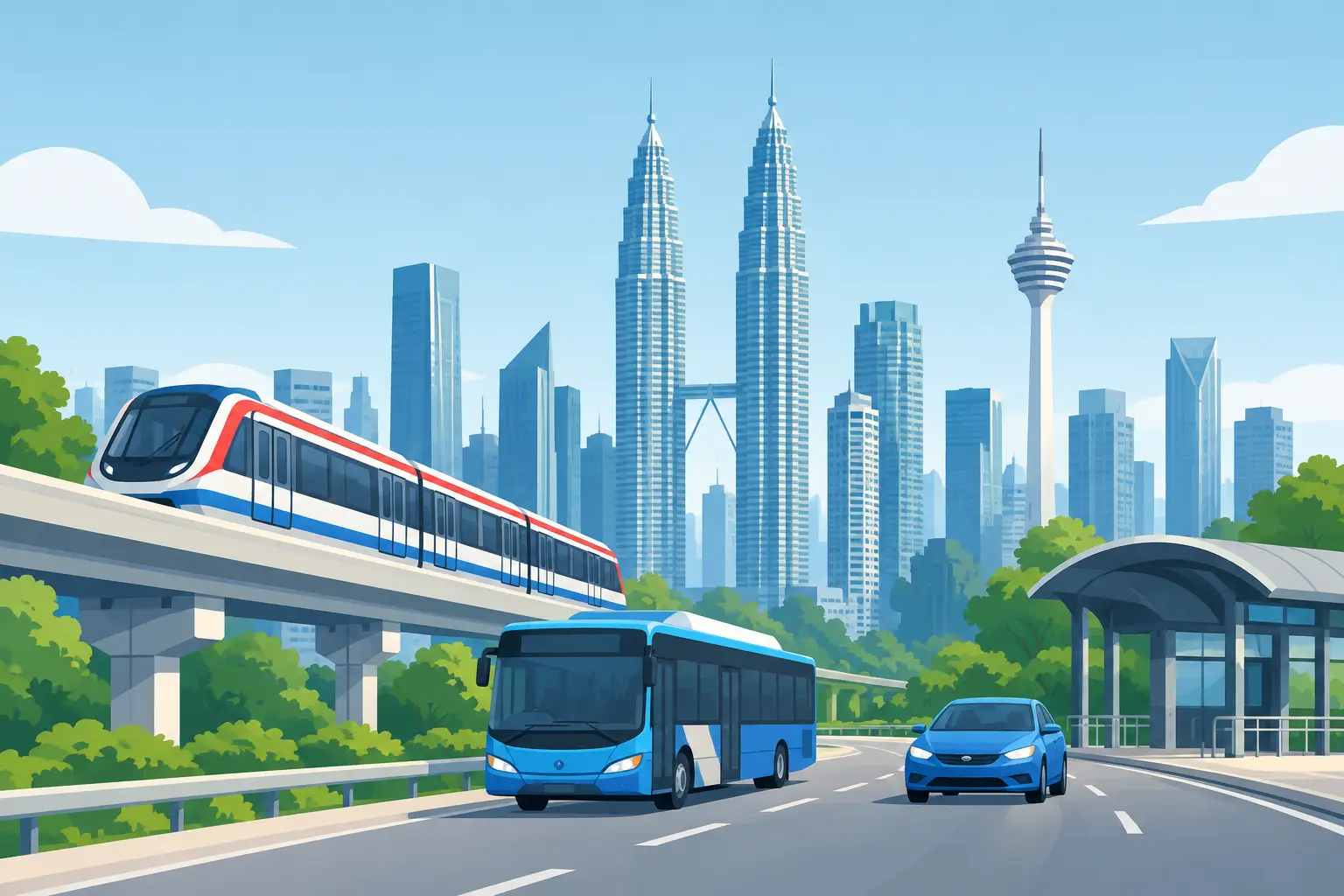
A delayed landing at KLIA, several suitcases, and a hotel across the city can turn a simple arrival into a logistical problem. Kuala Lumpur transportation works well when you choose the right option for the journey, not simply the lowest advertised fare. Rail is fast for some routes, ride-hailing is useful for short city trips, and a pre-booked private transfer removes uncertainty when timing, luggage, children, or a long-distance destination are involved.
For most visitors, the practical question is not whether Kuala Lumpur has transport. It does. The question is how to combine airport access, city travel, and day trips without losing time to queues, changing vehicles, or unexpected pricing.
Kuala Lumpur Transportation at a Glance
Kuala Lumpur is spread across several busy districts, while its main international airport sits roughly 35 miles from the city center. That distance shapes the best choice after arrival. A train can be efficient if your destination is near a central station and everyone can manage their luggage. A taxi or ride-hailing vehicle may suit a short, simple trip. Private transportation is often the more dependable choice for direct hotel pickup, late-night travel, families, and groups.
Within the city, the rail network connects many popular business, shopping, and visitor areas. The MRT, LRT, monorail, and commuter rail services are generally affordable and useful during daylight hours. However, stations do not always place you at your hotel entrance, and interchanging with bags can be tiring after a long flight.
The best option depends on three things: where you are going, how many people are traveling, and how much certainty you need.
Airport Transfers: KLIA and KLIA2 to Kuala Lumpur
KLIA and KLIA2 are connected to central Kuala Lumpur by express rail and road. The express train is one of the quickest ways to reach the city center, but it runs on a fixed route. Once you arrive at the central station, you may still need another vehicle to reach your accommodation.
For travelers staying near KL Sentral with light luggage, rail can be a sensible choice. It is also a good option for solo travelers arriving during normal operating hours who are comfortable finding their way onward.
A fixed-rate private airport transfer is more suitable when the route needs to be door to door. Your driver meets the agreed pickup arrangement, handles the journey directly to your hotel, residence, office, or meeting location, and avoids the need for a second transfer. This is especially helpful for families with strollers, travelers carrying sports equipment or large bags, and groups that would otherwise need multiple vehicles.
Flight timing matters as well. Arrivals can be delayed, immigration lines can be unpredictable, and late flights leave fewer convenient public transportation options. A pre-arranged service with flight monitoring provides more reassurance than trying to organize a ride after landing. With Cab2Travel, airport transfers can be confirmed in advance at a fixed rate, with vehicle sizes available for individuals, families, and larger groups.
When a private airport transfer is worth it
Private transport is not always necessary. If you are traveling alone, carrying a backpack, and staying beside a rail station, the train may be the better value. But private transfers make practical sense when convenience has a real benefit: a direct ride after a long-haul flight, a 24/7 pickup requirement, several passengers sharing the cost, or an address outside the rail network.
The key advantage is predictability. You know who is collecting you, where you are going, and what the ride costs before travel begins.
Getting Around the City
Kuala Lumpur’s rail network is usually the most efficient way to avoid road congestion during peak periods. It is useful for travel between major neighborhoods, shopping centers, and central business areas. If your itinerary includes several stops near stations, public rail can save both time and money.
For destinations beyond easy walking distance from a station, ride-hailing can fill the gap. It is convenient for point-to-point city trips, particularly when rain makes walking less appealing. The trade-off is that fares and vehicle availability can change with demand, weather, and major events. Pickup points at large malls, stations, and hotels can also be busy.
Traditional taxis remain available, though visitors should confirm that the meter is used or agree on the fare before starting a trip. This is a basic precaution, especially for travelers unfamiliar with local routes.
For business travelers, families, and visitors with a full schedule, booking a private vehicle for several planned stops can reduce friction. Rather than coordinating separate rides between a hotel, meeting venue, restaurant, and attraction, the day can follow a confirmed itinerary. It is not the cheapest approach for every trip, but it can be the most efficient when time matters more than a small difference in fare.
Choosing Transportation for Families and Groups
Groups face a different set of transportation decisions. Four people with carry-on bags may fit comfortably in one vehicle. Four people with full-size suitcases may not. The right vehicle is determined by both passenger count and luggage volume.
Using separate ride-hailing cars can appear inexpensive at first, but it creates coordination problems. One vehicle may arrive before the other, drivers may take different routes, and the group can become separated at a hotel, airport, or attraction. A private MPV or van keeps everyone together and gives the driver a clear destination and schedule.
Families should also account for child seats, mobility needs, and the amount of time they want to spend waiting. These details are easier to arrange before arrival than at an airport curbside. When booking, provide the number of passengers, number of bags, flight details, and any special requirements. Clear information helps ensure the appropriate vehicle is assigned.
Kuala Lumpur Transportation for Day Trips
Kuala Lumpur is a practical base for trips beyond the city. Popular routes include Malacca, Genting Highlands, Cameron Highlands, Kuala Selangor, and Kuala Gandah. These journeys are where transportation choice has the greatest impact on the day.
Public transportation can work for selected destinations, but it often involves fixed schedules, terminal transfers, and limited flexibility once you arrive. That may be fine for travelers who prefer an independent itinerary and have extra time. It is less appealing when a group wants hotel pickup, multiple sightseeing stops, or a return trip on its own schedule.
A private intercity ride or guided day transfer gives you direct pickup and a defined return plan. For destinations such as Cameron Highlands or Kuala Gandah, the route itself can take several hours, so vehicle comfort and a professional driver familiar with long-distance travel matter. For Malacca, a private transfer can make sense for travelers with luggage who are continuing onward rather than returning to Kuala Lumpur.
Before confirming any day trip, check the realistic driving time, attraction opening hours, and whether your itinerary allows enough time at each stop. Trying to fit too much into one day is a common mistake. A well-planned route with fewer stops is usually more enjoyable than a rushed schedule built around transport connections.
How to Make Every Journey Easier
Start with your arrival and departure times. If your flight lands late or departs early, arrange airport transportation before you travel. Keep your hotel address available in full, including the property name and neighborhood, since similarly named buildings can exist in different areas.
For city travel, group nearby attractions on the same day and use rail where it fits naturally. Reserve private transport for airport journeys, long-distance routes, group travel, or days when several stops must run on time. This approach gives you the cost efficiency of public transportation without relying on it for situations where delays or transfers would create stress.
Finally, consider the full cost of a journey, not only the fare. A cheaper ride can become less valuable if it requires two transfers, extra waiting, or splitting a group across vehicles. The right transportation plan should leave you with more time for Kuala Lumpur and less time figuring out how to reach it.